The national debt has four payers: taxpayers, the people whose benefits get cut, savers and bondholders, and foreigners holding dollars. This piece is about the first, the only one who is handed a form and told the amount.
Taxes are the one way the government takes purchasing power out of the economy that does not involve a bond, a peg, or a price level. They are also, in the one period when the country used them at full strength, the most effective tool it has ever had against inflation. That period was the war.
The Mass Tax
In 1939 about 7.7M Americans filed an income tax return. The tax existed, it had for 26 years, but it was a tax on the comfortable. Roughly 5 percent of workers paid it. For everyone else it was something that happened to other people.
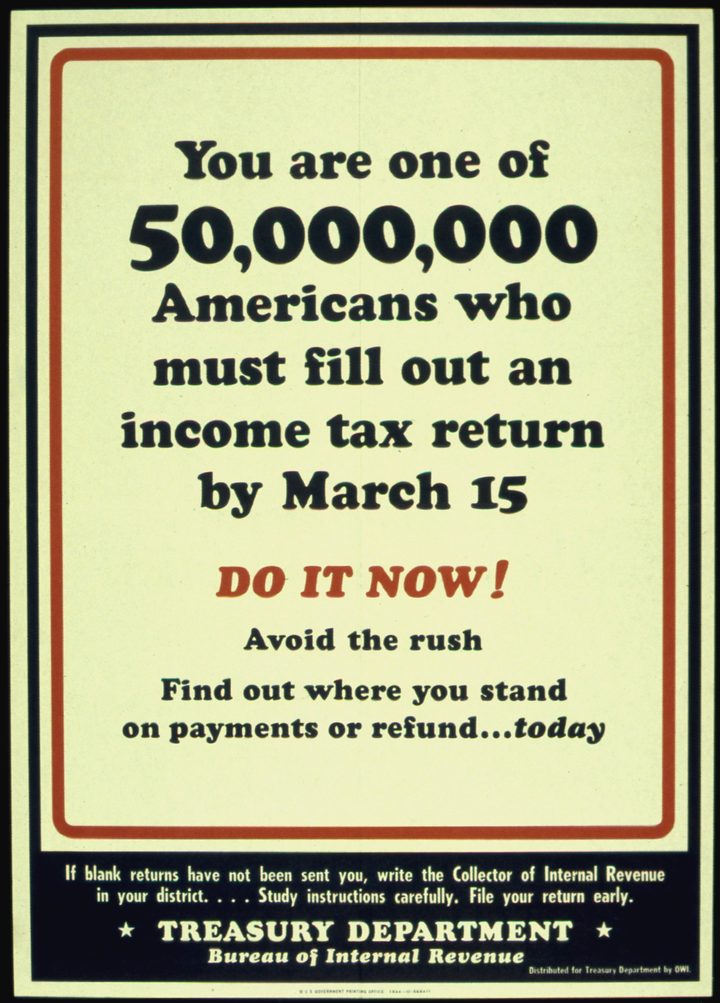
By 1945, 49.9M returns were filed. Six and a half times as many, in 6 years. By the government's own account 9 in 10 workers were filing and 6 in 10 were actually paying, and the machinery that made that possible, withholding from the paycheck before the worker ever saw it, was built in 1943 and has run without interruption since.
The money followed. Federal receipts were 6.4 percent of the economy in 1940. In 1945 they were 19.8 percent. In dollars they went from $6.5B to $45.2B, nearly 7 times over, in 5 years.
The war is the only vertical line on the chart. Everything before is a small tax on a few people. Everything after is a large tax on nearly everyone, holding between roughly 15 and 20 percent of the economy for 80 years regardless of which party wrote the rates. The mass tax was built for a war and never went home.
Why It Fights Inflation
The tax and the war bond did the same job. Then they parted.
Both took dollars out of the worker's hands at the moment the factories had stopped making things to spend them on. A dollar in a bond or a dollar in a tax was a dollar not chasing a scarce refrigerator, and that is how prices were held during the fighting. The point of both programs was not only to raise money. It was to remove spending power before it could push the price level.
The difference is what happened afterward. The bond gave the dollar back. $18.75 became $25, the money came out of the drawer, and it arrived in 1951 in an economy that had just absorbed the postwar price jump. The purchasing power the bond had taken out was returned, minus the inflation, right when it was least welcome. The bond postponed.
The tax never gave anything back. The dollar was gone. The purchasing power it represented was removed from the economy permanently, spent by the government on the war, and never returned to circulation as a claim. That is why the tax, and not the bond, is the tool that actually prevents inflation rather than delaying it. A bond is a loan from the citizen. A tax is not.
The Stub
The thing that made the mass tax possible was not the rate. It was the stub.
Before 1943 an income tax was a check you wrote, once a year, for a sum you had to have saved. That works for 7M comfortable people. It does not work for 50M wage earners, most of whom have never had a lump sum in their lives. So the government moved the tax to the payroll, took it out before the worker was paid, and printed what was left on a piece of paper.
The payroll savings plan that sold the war bonds worked the same way, in the same year, for the same reason. Take it before they see it. The wartime genius was not in persuading people to give up purchasing power. It was in designing the giving-up so that it never appeared as a decision.
The stub is where the fourth payer lives. It is the one place where the removal of purchasing power is written down, with a number, on a document the worker actually holds. The quarter does not come with a stub. Neither does the hour of work that buys less beef. The tax is the only loss that is itemized, and it is itemized precisely so that it can be taken automatically.
The Comfortable Case
A tax is honest. It is voted on, published, argued over, and collected in the open. Its rates are progressive, so the comfortable pay a larger share than the struggling, which is the opposite of what inflation does. It funds real things, and in 1945 it funded the largest single project in the country's history without the country going broke. And the mass tax it created paid, over the next generation, for the roads, schools and universities that built the middle class it had been levied on.
More than that, a tax is chosen. Inflation is not. When the government removes purchasing power through the price level, nobody voted for the amount and nobody knows the amount. When it removes purchasing power through a tax, the amount is on the stub. If you had to pick which way to be made poorer, the stub is the one with your name on it and a number you can argue with.
All of that is true. It leaves one thing out.
The Ceiling
For 80 years federal receipts have held between about 15 and 20 percent of the economy. Top rates have been 91 percent and 28 percent and most numbers in between, and the share barely moves. There seems to be a level of taxation the country will actually pay, and it has been found, and it is not enough.
Not enough for what the government spends. The gap between what the stub collects and what the government spends is the deficit, and the deficit is what gets borrowed, and what gets borrowed is what gets diluted. The mass tax is the fourth payer, but it has never been a large enough payer to retire the other three. It pays what it pays and the leak covers the rest.
So the two tools sit side by side. One takes purchasing power openly, on a form, up to a ceiling the country will tolerate. The other takes it quietly, in the price of everything, with no ceiling at all, because nobody is asked. I have written about what the quiet one does to a house and a wage. What the loud one does is stop at about a fifth of the economy and hand the rest of the job to the quiet one.
The Stub, Again
Look at a paycheck stub. There is the gross, there is the withholding, there is what is left. That middle line is the only place in the entire economy where the government's claim on your purchasing power is printed for you to see.
It is not the whole claim. It is the part that stops at the ceiling. The remainder is collected in the checkout line, at the closing table, in the drawer, and none of those come with a line item.
Which brings the series back to where it started. Whether the loud payer and the quiet one together are enough, or whether the debt compounds faster than both of them can carry it, is a question of two rates. One is what the government pays. The other is how fast the economy grows. That is the piece that opens all of this, and it is the one to read next if you have not.
Figures: number of individual income tax returns from the Internal Revenue Service, Statistics of Income historical tables. Share of workers filing and paying from the IRS's own history of the Victory Tax. Federal receipts in dollars and as a share of gross domestic product from the Federal Reserve Economic Database, series FYFR and FYFRGDA188S.
This is general economic writing and not financial advice. Nothing here is a recommendation to buy, sell or hold anything, and none of it accounts for your circumstances.