The debt gets paid through inflation, slowly, by whoever is holding the dollar when its value leaves. If rising prices are how the holder loses, would falling prices not be how the holder wins? Cheaper groceries, a cheaper house, a dollar that buys more every year. It sounds like the one policy everybody would vote for.
The country ran that experiment once, from 1929 to 1933, and it was the worst 4 years in its economic history. Not in spite of the falling prices. Because of them.
The Arithmetic
Between 1929 and 1933 consumer prices fell 25 percent. The economy, measured in the dollars it actually produced, fell 45 percent. Prices fell, and on top of that, the amount of stuff being made and sold fell too, so the total flow of dollars through the country was cut almost in half.
Now look at the debt. Federal debt was $16.9B in 1929 and $22.5B in 1933. It rose by a third, which is what you would expect when tax receipts collapse and relief spending begins.
Except that the debt is measured against the economy, and the economy had halved. Debt went from 16 percent of the country's output to 39 percent in 4 years. It more than doubled as a burden while rising by a third in dollars, and most of the doubling came not from borrowing but from the denominator falling out from under it.
This is the leak run backwards. In the piece on the war debt I showed the ratio falling from 119 percent to 54 percent while the debt in dollars barely moved, because the economy grew underneath it. Here the debt in dollars barely moved and the ratio exploded, because the economy shrank underneath it. Whoever owes a fixed number of dollars is helped when dollars get cheaper and crushed when dollars get dearer, and from 1929 to 1933 dollars got very dear.
The Household
The federal government was, in 1929, a small borrower. Most of the country's debt was private: mortgages, farm loans, business credit, margin loans on stocks. And every one of those was a fixed number of dollars, signed when a dollar was worth what it was worth in 1929.
Put yourself in a farmhouse in 1930. The mortgage says $5,000. It said $5,000 last year and it will say $5,000 next year. But wheat sells for less than it did, and so does the farm, and so does an hour of anyone's labor. The number on the mortgage did not move. Everything that was supposed to pay it did.
I have written elsewhere about what a house costs in hours of work, and how inflation quietly shrinks a mortgage by making the dollars used to repay it cheaper than the dollars that were borrowed. Deflation does the exact reverse, and it does it to every borrower in the country at the same time. The debt was fixed. The hours required to earn each dollar of it went up by a quarter in 4 years. The borrower had not borrowed any more. The dollar had simply become heavier.
The Spiral
What turns a bad year into a decade was described in 1933 by an economist named Irving Fisher, who had lost a fortune in the crash and spent the rest of his life working out why.
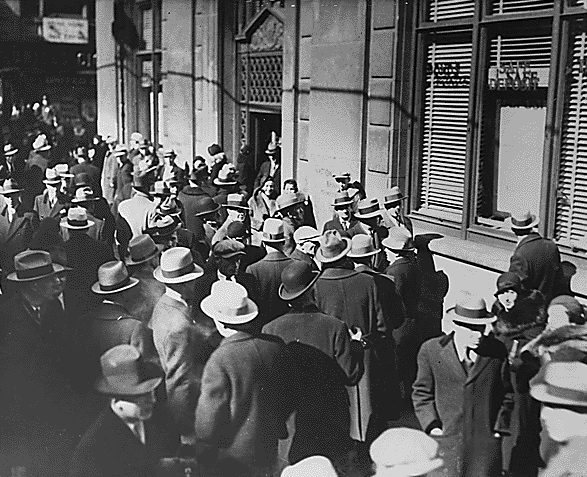
A borrower who cannot make the payment sells something. A farm, a stock, inventory, a truck. Selling pushes the price of that thing down. A lower price means the next borrower's collateral is worth less, so the bank calls that loan, and that borrower sells too. Every sale to repay debt lowers prices, and every lower price makes the remaining debt heavier, which forces more selling. Fisher's phrase for it was that the more the debtors pay, the more they owe.
You can watch it happen in the bond market. In 1929 a solid but not top-tier corporate borrower paid about 2.3 percentage points more than the Treasury to borrow. By 1932 that gap was 5.5 points. Lenders were not being greedy. They were pricing the odds that the borrower, whose revenue had halved and whose debt had not, would fail to pay. Thousands did. I have written about that gap, and why it opens for one kind of borrower and never for the other. Deflation does not lower the debt. It raises the chance the debt is never paid at all.
The Long Version
That was 4 years. Japan is the 30-year version.
Japan's consumer prices in 2020 were 12 percent higher than in 1990. Prices in the United States rose more than that in the 3 years after 2020 alone. Japan spent three decades with almost no inflation, a few stretches of outright deflation, and a central bank trying every tool it had to generate the 2 percent that everyone else was trying to suppress.
Over those same 30 years its government debt went from 63 percent of the economy to 258 percent.
That is not because Japan borrowed recklessly. It is because nothing was leaking. In the American postwar case, the debt sat still and inflation plus growth shrank it against the economy underneath. In Japan the denominator barely grew in dollar terms because prices barely moved, and so every yen borrowed stayed a full yen of burden, forever, stacking on the last one. The country is not bankrupt and there is no crisis. There is just a debt two and a half times the size of the economy that cannot get smaller because the tool that shrinks debts has been switched off.
This is what the comfortable version of the American story leaves out. Growing your way out of the debt requires the nominal economy to grow, and about half of that growth, historically, has been the price level. Take the price level away and the debt does not get paid. It just waits.
The Comfortable Case
The strongest objection to all this is that falling prices are not always a catastrophe, and that is true.
The United States had falling prices for most of the period from 1870 to 1900 and it was one of the great growth eras in its history. Railroads, steel, electricity, oil. Prices fell because the country was getting better at making things, and a dollar bought more every year because there was more to buy. Nobody calls that a depression.
The difference is debt. Deflation that comes from abundance, in an economy without much leverage, is a gift. Deflation that comes from a collapse in spending, in an economy where everything is borrowed against, is a trap, because it makes every existing promise heavier at exactly the moment the borrower is least able to carry it.
And the modern economy is the second kind. Houses, cars, educations, businesses, governments. Nearly everything is a fixed number of dollars owed against an income that is not fixed. That is why the central bank targets 2 percent inflation rather than zero, and why it will tolerate a great deal of the slow leak before it will risk the weight. It has read the 1930s. It is choosing the loss it can control over the one it cannot.
I have written about that choice at length, and why it means the debt is never repaid so much as diluted. Here is the reason the dilution is preferred. The alternative is not repayment. The alternative is 1932.
The Weight
A debt is a number of dollars. That is all it is. It does not know what a dollar buys.
When the dollar loses value, the debt gets lighter and the lender carries the loss, quietly, in the drawer, the way 85 million war bond holders did. When the dollar gains value, the debt gets heavier and the borrower carries the loss, loudly, in foreclosure and bankruptcy and closed banks. Somebody always carries it. The only choice is which side, and how visibly.
Every government since 1933 has made the same choice, and it is the reason the leak exists. Not because anyone wanted the holder to lose, but because they had seen what happens when the borrower does, all at once, with the whole country on the hook.
Which leaves the government with one more tool for taking purchasing power out of the economy, the one that does it openly, on a form, once a year, without any bond at all. That is the next piece.
Figures: consumer price index and gross domestic product from the Federal Reserve Economic Database, series CPIAUCNS and GDPA. Federal debt from the Treasury's historical debt outstanding series. Corporate and Treasury yields from Moody's Baa index and the long-term government bond series, both via the Federal Reserve Economic Database. Japanese consumer prices and general government debt from the OECD and IMF via the Federal Reserve Economic Database, series JPNCPIALLMINMEI and GGGDTAJPA188N.
This is general economic writing and not financial advice. Nothing here is a recommendation to buy, sell or hold anything, and none of it accounts for your circumstances.